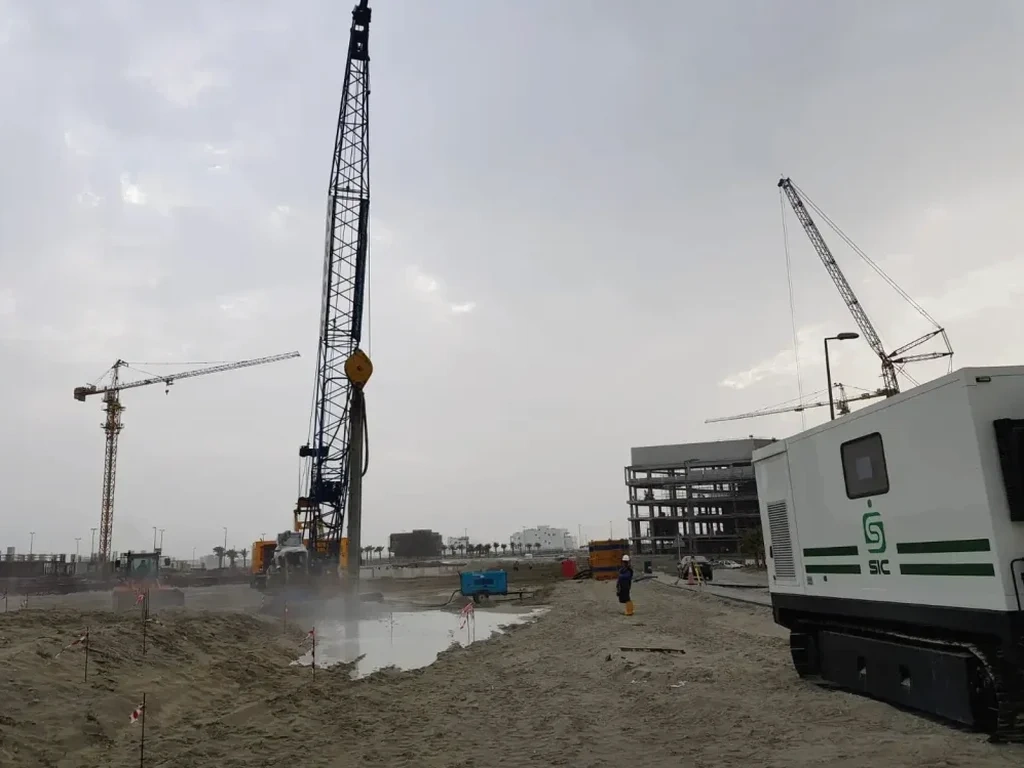
The vibrator probe hits the loose sand at 1800 RPM. Water jets kick in. The ground around Springfield trembles slightly as the granular matrix collapses into a denser state. Our team runs this equipment on sites from the Sangamon River floodplain to the commercial strips off Veterans Parkway. We control the amperage draw in real time. That spike tells us when the soil pores have collapsed and the compaction radius has peaked. It is a direct measurement. No guesswork. We combine this field data with SPT blow counts to confirm the design. The goal is a homogeneous mass under your footing that will not settle unevenly when the freeze-thaw cycles hit in January.
We measure amperage in real time during vibrocompaction. When the spike stabilizes, the sand grains have locked. That is your bearing capacity.
Service characteristics in Springfield Illinois
Local geotechnical conditions in Springfield Illinois
The soil between the west side neighborhoods near Washington Park and the new subdivisions out by Panther Creek is not the same. Near the city core, you hit old backfill and loose alluvial sands from historic creek beds. Out east, the glacial till is shallower and the sand lenses are cleaner. A vibrocompaction design that works for Panther Creek's uniform sands will fail in the mixed fills downtown. We see it often. The contractor applies a standard triangular grid and the amperage never stabilizes. That means the fines content is too high. You are just vibrating mud. We design the probe spacing and energy input based on a pre-construction investigation. We sample at multiple depths. We adjust the grid in real time if the subsurface changes. Skipping that site-specific tuning leads to differential settlement and cracked slab-on-grade floors within two winters.
Our services
We deliver a complete vibrocompaction package from the initial site investigation to the final compaction verification. Our field crew operates the vibrator rig. Our lab runs the index tests. Our engineer signs off on the bearing capacity.
Pre-Compaction Site Investigation
We drill SPT borings and push CPT soundings to map the loose zones. We classify every sample in our lab per ASTM D2487. This defines the design grid and energy input.
Vibrocompaction Field Execution
We mobilize a vibrator probe with water jetting capability. Our operator monitors amperage and penetration rate. We adjust the grid on the fly based on real-time soil response.
Post-Compaction Verification Testing
We re-drill the SPT borings or push CPT soundings at the same locations. We compare pre- and post-blow counts to confirm the design density has been achieved across the entire site.
Questions and answers
How much does a vibrocompaction design and execution project cost in Springfield?
For a typical residential or light commercial lot in Springfield, the complete package (site investigation, design, field execution, and verification) ranges from US$1,650 to US$5,850. The final cost depends on the depth of the loose layer, the grid spacing required, and the total square footage.
How long does the vibrocompaction process take on a standard lot?
The field work for a standard quarter-acre lot usually takes two to three days. We spend the first day on the pre-compaction borings. The vibrator rig completes the probe grid on the second day. We return on the third day for the verification borings. Lab testing and the final stamped report add another week.
Will the vibration damage my neighbor's house or the street?
We monitor peak particle velocity with a seismograph placed at the property line. We stay below the threshold that would cause cosmetic cracking in typical Springfield frame construction. The energy dissipates quickly in loose sand. It is not like rock blasting.
Can vibrocompaction fix the fill that was placed without compaction?
Yes, if the fill is granular and less than about 20 feet thick. The vibrator probe can remold and densify poorly placed sand fill. If the fill contains a lot of silt or clay, vibrocompaction alone will not work. We would need to switch to stone columns or remove and recompact the material. More info.