If you dig on the west side of Springfield, near Washington Park, you will find a dark, clayey layer with high plasticity that has nothing to do with the sandy loam that appears east of I-55, almost reaching the Sangamon River floodplain. That contrast explains why the same foundation type works in one sector and causes differential settlement in another. A soil mechanics study in the capital does not just classify strata; it connects the geological history of the Sangamon basin with the mechanical parameters the structural engineer needs. From subdivisions in the Piper Glen area to industrial expansions along Dirksen Parkway, we conduct the characterization under ASTM D2487 and correlate results with IBC requirements so the bearing capacity values are not an assumption but a verified number.
The difference between a foundation that performs and one that generates claims often lies in correctly interpreting the moisture-sensitive clays of the Sangamon basin.
Service characteristics in Springfield Illinois
Local geotechnical conditions in Springfield Illinois
The Illinois State Geological Survey maps the Springfield area with a Quaternary sediment thickness that in some sectors exceeds 100 feet, and that is not a minor detail. The Sangamon aquifer, which supplies the city, maintains a relatively high water table that, combined with the low-permeability clays of the Glasford Formation, creates a scenario of prolonged consolidation under load. Ignoring this behavior leads to post-construction settlements that crack partitions and misalign door frames. To the west, the presence of abandoned coal mine tunnels from the 19th century adds a subsidence risk that you cannot detect with a superficial inspection. A geophysical survey with electrical resistivity helps identify those voids before the backhoe arrives, and that is the type of proactive measure that saves general contractors costly standstills.
Our services
We deliver the laboratory and field package that the geotechnical report for the City of Springfield building permit requires, with traceable chain of custody from sampling to final interpretation.
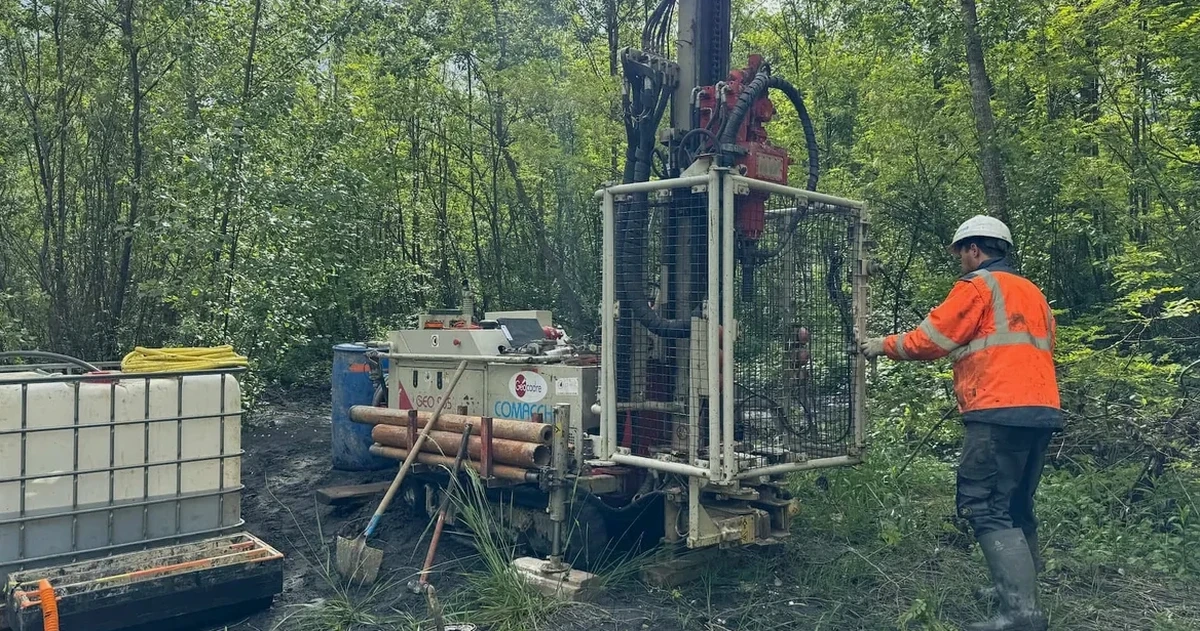
Soil sampling with SPT
Drilling with split-spoon sampler to obtain N-values and disturbed samples per ASTM D1586, correlating with IBC site class.
Laboratory testing program
Consolidation, direct shear, Atterberg limits and grain size distribution to model strength and settlement over time.
Geotechnical interpretive report
Document with allowable bearing capacity, anticipated total and differential settlements, and recommendations for shallow or deep foundations.
Questions and answers
What is the typical allowable bearing capacity in Springfield, IL?
In the silty clays typical of the Springfield plain, the allowable bearing capacity for shallow footings usually ranges between 2,000 and 3,500 psf, depending on the consistency of the stratum and the depth of embedment. That figure must be confirmed with SPT data and laboratory tests, because in areas near the Sangamon River floodplain it can drop below 1,500 psf.
What does a soil mechanics study include and when is it required by the city?
It includes field exploration with SPT borings, laboratory classification and strength tests, and an interpretive report with foundation recommendations. The City of Springfield building department requires it for any new commercial or multi-family construction and for residential additions exceeding 500 square feet, in accordance with Chapter 18 of the IBC adopted by the city.
How much does a soil mechanics study for a single-family home in Springfield cost?
For a standard residential lot in the capital, the study ranges between US$3,540 and US$5,140, depending on the number of borings, the depth required, and whether laboratory tests such as consolidation or direct shear are included. Lots with fill or near Lake Springfield may require additional investigation.
How long does it take to deliver the results of a geotechnical study in the Springfield area?
Fieldwork is completed in one or two days. The laboratory phase takes between 10 and 15 business days, depending on the testing program. The final report is delivered within three weeks of mobilization, provided weather conditions allow drilling.
Do they work under ASTM standards and IBC for projects in Illinois?
Yes, our laboratory operates under ASTM D2487, D1586, D2435, D3080, and D4318, among others, and we correlate results with the seismic site classification of ASCE 7-22 and the IBC adopted by the State of Illinois. The chain of custody is documented from sampling to the final report.