A common mistake in central Illinois construction is assuming uniform soil conditions. In Springfield, the presence of shallow limestone bedrock in the northeast contrasts sharply with the deep alluvial deposits near Lake Springfield. Contractors who skip a geophysical survey before auger drilling often hit refusal unexpectedly, causing redesign costs and delays. Electrical resistivity surveys map this subsurface variability without excavation. Our team applies Vertical Electrical Sounding (VES) and 2D resistivity imaging per ASTM D6431 to delineate bedrock topography, identify paleochannels, and detect karst features. This non-intrusive method quantifies resistivity contrasts between clay-rich glacial till, water-bearing sand lenses, and the underlying St. Louis Limestone. The result is a continuous profile that guides boring locations and foundation depth decisions.
A VES survey in Springfield can map the top of weathered limestone bedrock within a six-inch tolerance, eliminating blind drilling into pinnacled karst surfaces.
Service characteristics in Springfield Illinois
Live process video
Local geotechnical conditions in Springfield Illinois
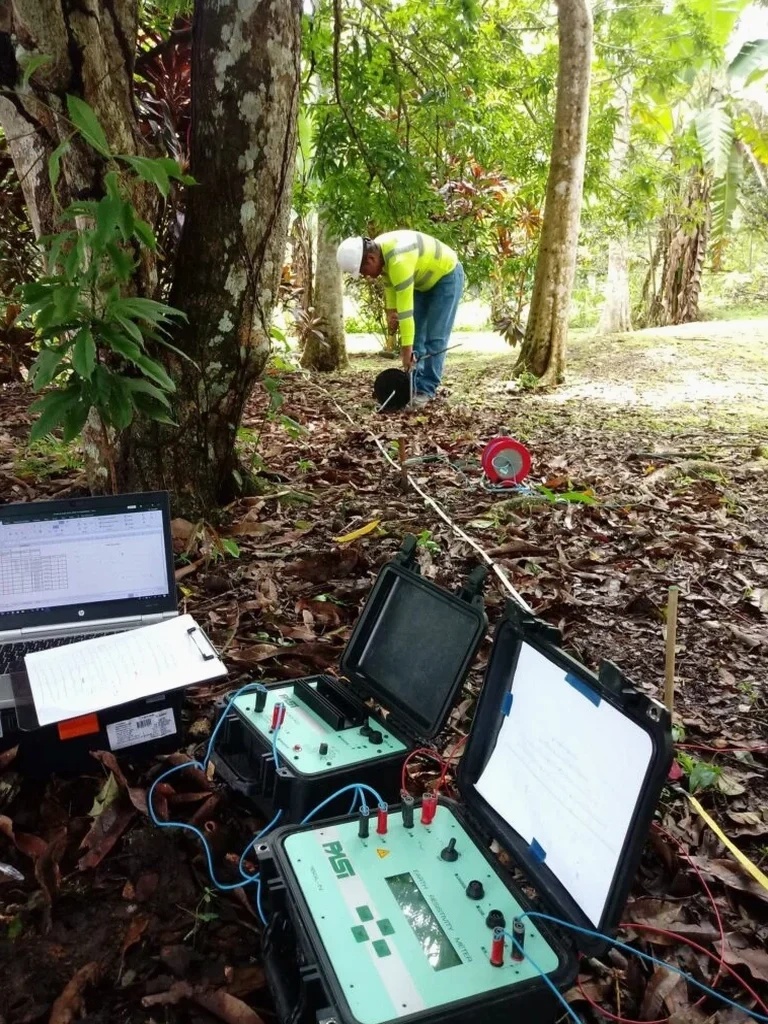
The field equipment includes a Syscal Pro resistivity meter, multi-core cables with stainless steel electrodes, and a high-power transmitter for deep soundings. In Springfield's urban environment, buried utilities and reinforced concrete generate cultural noise that distorts apparent resistivity readings. Our technicians mitigate this by running reciprocal measurements and filtering outlier data points during inversion. Karst cavities in the St. Louis Limestone pose an additional challenge. An air-filled void shows near-infinite resistivity, while a clay-filled sinkhole reads as a conductive anomaly. Misinterpreting these signatures leads to mischaracterized site class per IBC Table 1613.2.1. We cross-reference resistivity anomalies with available IDOT boring logs and Sangamon County well records to validate interpretations before delivering final cross-sections.
Our services
We offer two tiers of electrical resistivity activities tailored to Springfield's geological conditions and project scale.
Vertical Electrical Sounding (VES)
One-dimensional depth sounding using Schlumberger array expansion. Ideal for mapping horizontal layering and depth to bedrock at a single point. Applied for preliminary foundation studies and groundwater exploration in the Illinois Basin.
2D Electrical Resistivity Tomography (ERT)
Multi-electrode profile imaging along a transect. Resolves lateral and vertical variations simultaneously. Essential for detecting sinkholes, abandoned mine workings, and fracture zones in the limestone bedrock underlying Springfield.
Questions and answers
How much does an electrical resistivity survey cost in Springfield, IL?
Electrical resistivity surveys in the Springfield area typically range from US$550 to US$1,090. The final cost depends on the array length, maximum investigation depth required, and whether a single VES sounding or a full 2D tomography line is needed.
What depth can a VES survey reach in central Illinois?
With a standard 400-foot cable spread and Schlumberger array geometry, VES surveys in Springfield reliably reach depths between 80 and 120 feet. Extending the current line to 800 feet can push investigation depth to approximately 200 feet, limited by the natural voltage signal-to-noise ratio.
Can resistivity detect sinkholes before excavation starts?
Yes. Air-filled karst cavities in the St. Louis Limestone exhibit a strong high-resistivity anomaly relative to the surrounding saturated till. Our 2D ERT profiles map these features as distinct bullseye anomalies, allowing geotechnical engineers to adjust foundation plans or plan grouting programs before excavation begins.
How does weather affect resistivity data quality in Illinois?
Heavy rainfall saturates the near-surface clay layer, lowering contact resistance and improving data quality. Frozen ground in January and February creates a high-resistivity cap that blocks current injection. We schedule Springfield field campaigns between March and November for optimal electrode coupling and reliable depth penetration.