Springfield's downtown historic district near the Old State Capitol sits on very different ground than the commercial strips out by Veterans Parkway. Downtown, you're dealing with older fill and silty clays that can hide old foundations or utilities, while the western development areas often hit dense glacial till much sooner. For any deep excavation, this contrast means you can't just copy a shoring design from one side of town to the other. We see it all the time: a contractor assumes stiff soil everywhere because one job went smooth, then hits soft lake deposits downtown and faces excessive wall deflection. Our geotechnical approach ties the excavation support system directly to the specific subsurface conditions of your Springfield site, whether it's a hospital expansion near Memorial Medical Center or a new parking structure downtown. We rely on site-specific data, combining SPT drilling to characterize soil strength with laboratory testing to define the parameters used in the shoring design.
The difference between a successful deep excavation and a costly failure in Springfield often comes down to how well you understand the groundwater table before you dig.
Service characteristics in Springfield Illinois
Local geotechnical conditions in Springfield Illinois
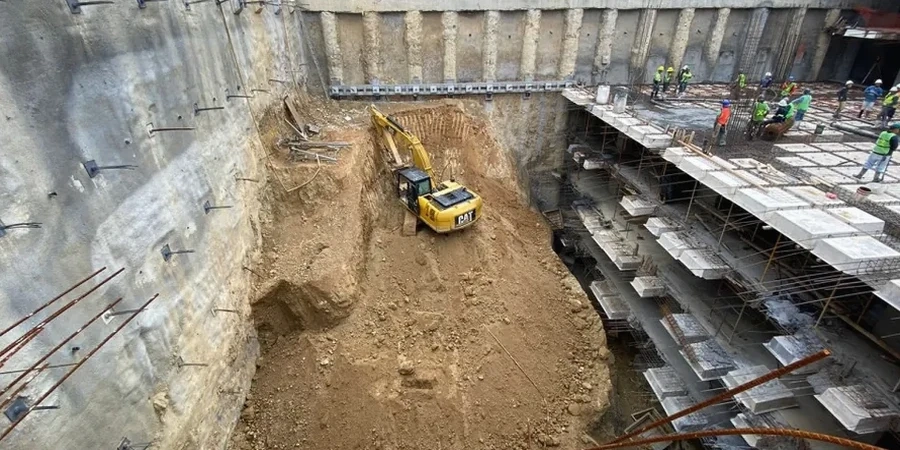
Springfield sits on a sequence of Quaternary deposits, with Wisconsinan glacial till overlying Pennsylvanian bedrock. The till itself is generally competent, but the upper 10 to 20 feet often consists of loess and water-bearing silty sand lenses that can collapse or flow when exposed in an open cut. The water table fluctuates seasonally and can be encountered as shallow as 5 to 8 feet below ground surface in lower-lying areas near the Sangamon River and its tributaries. If your excavation goes below that level without adequate dewatering and base stability checks, you risk bottom heave, piping, or even a catastrophic blowout. In the downtown area, the proximity of century-old brick buildings with shallow foundations adds a layer of risk: even small ground movements can translate into significant structural damage. Our designs specifically account for these local hydrogeologic conditions to prevent such outcomes.
Our services
Our deep excavation design service in Springfield covers the full engineering package needed to move from concept to construction. We start with a review of your project requirements and deliver stamped calculations and drawings ready for city permit submission.
Shoring Design and Analysis
We develop excavation support plans using limit equilibrium and numerical modeling methods. This includes soldier pile and lagging walls, sheet pile cofferdams, and secant pile walls. Each design addresses lateral earth pressures, surcharge loads from adjacent buildings, and internal bracing forces. We offer detailed construction sequence drawings showing strut elevations, preload requirements, and critical stages where monitoring is required.
Base Stability and Groundwater Control
For excavations extending below the groundwater table, we design dewatering systems and evaluate basal heave safety factors using methods from Terzaghi and the U.S. Army Corps of Engineers. We specify wellpoint spacing, deep well pump capacities, and cutoff wall depths to maintain a dry, stable excavation bottom. Where the risk of piping or sand boils is high, we detail the required filter materials and relief well installations.
Questions and answers
What does deep excavation design typically cost for a project in Springfield?
For most commercial building excavations in Springfield, the geotechnical design package ranges from US$2,130 to US$7,410 depending on the excavation depth, wall type, and whether groundwater control systems need to be designed. A simple single-tier soldier pile wall for a 15-foot basement will be at the lower end, while a multi-level tied-back wall with a complex dewatering system for a 40-foot cut will fall at the higher end.
How long does it take to get a stamped shoring design for a building permit?
Assuming the geotechnical site investigation is already complete and we have the soil boring logs and lab test results, we can typically deliver a stamped set of excavation support drawings and calculations within two to three weeks. For more complex projects involving 3D finite element analysis or coordination with a structural engineer for permanent walls, the timeline may extend to four or five weeks.
Do you handle the special inspections during excavation in Springfield?
Yes, we offer the required observation and inspection activities during construction. Our engineers visit the site to verify that the shoring installation matches the design, confirm tieback anchor capacities through load testing, and review inclinometer readings to ensure wall movements stay within acceptable limits. This documentation is essential for OSHA compliance and for the city's building department records.
What are the OSHA requirements for excavations deeper than 20 feet in Illinois?
OSHA 29 CFR 1926 Subpart P requires that excavations 20 feet or more in depth have a support system designed by a registered professional engineer. The design must address soil classification, surcharge loads, water conditions, and the specific shoring materials to be used. In Springfield, this means you need stamped plans showing wall sections, bracing details, and a clear sequence of installation before you can obtain a permit to dig. Our designs meet these federal and state requirements.