The silty clay loess that blankets much of central Illinois creates a specific challenge for pavement designers in Springfield. This wind-deposited soil, prevalent across Sangamon County, can lose significant strength when saturated, and with Springfield averaging over 38 inches of annual precipitation, moisture is a constant variable in subgrade performance. The Laboratory CBR test provides the critical soaked strength value that determines whether the native soil can support a pavement structure or requires stabilization. Our lab runs these tests under tightly controlled conditions, compacting specimens at optimum moisture content and submerging them for 96 hours to simulate the worst-case field scenario under a saturated pavement section. For projects where the subgrade shows marginal soaked CBR values, we often recommend pairing this test with a grain size analysis to check the fines content that drives moisture sensitivity, or a plate load test to verify in-situ modulus on the compacted lift before paving begins.
A soaked CBR value below 3 percent almost always demands subgrade stabilization or a thicker aggregate base course in this part of Illinois.
Service characteristics in Springfield Illinois
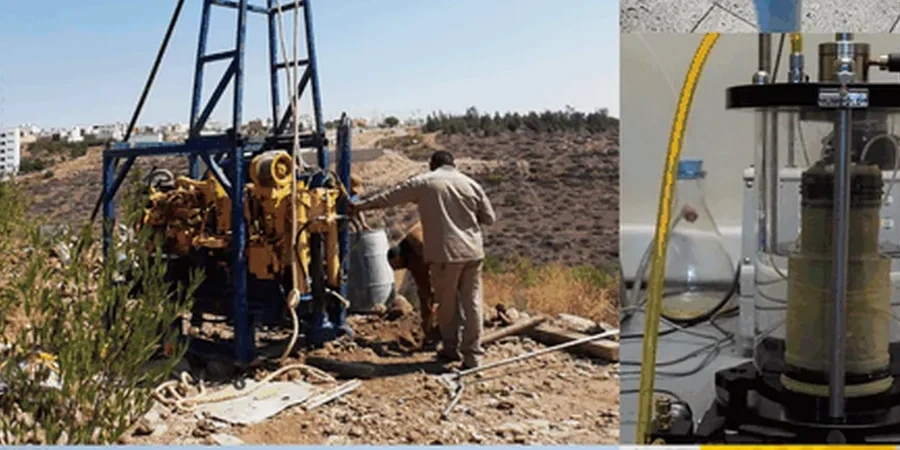
Local geotechnical conditions in Springfield Illinois
The IBC and ASCE 7 requirements for site characterization in Springfield place a direct emphasis on subgrade bearing capacity under saturated conditions, and skipping the laboratory soaked CBR carries real liability for the pavement section. A designer relying on dry-season unsoaked values can underestimate the thickness of base course needed, and the result surfaces within three to five years as alligator cracking along wheel paths. The problem intensifies in subdivisions built on former agricultural land where decades of tillage have aerated the upper soil profile, producing a fluffy crust that collapses under traffic loading once water infiltrates. We have seen pavement cores from failed parking lots in Springfield where the aggregate base was clean and well-graded, but the underlying silty clay subgrade had turned to slurry because the design assumed a CBR that only held true in August. A defensible CBR test program, including both soaked and unsoaked runs on representative samples from each major soil unit, provides the documentation that an engineer needs to justify the pavement design to the owner and the reviewing agency.
Our services
Beyond the basic soaked CBR determination, we offer a range of supporting laboratory and field activities that strengthen the geotechnical basis for pavement and earthwork design in the Springfield area.
Compaction Testing and Proctor Curves
We develop standard and modified Proctor curves per ASTM D698 and D1557 to establish the target density and moisture content for field compaction. These curves are the foundation for interpreting CBR values and for quality control during earthwork.
Soil Classification and Index Testing
Using ASTM D2487 (Unified Soil Classification System), we run particle-size distribution, Atterberg limits, and specific gravity to classify the subgrade soil. This classification drives the selection of the appropriate CBR surcharge and predicts long-term volume-change potential.
Lime and Cement Stabilization Mix Designs
When soaked CBR values fall below the project threshold, we prepare treated specimens with varying percentages of lime or cement and retest the CBR after curing. This gives the designer a direct, quantified improvement curve for the stabilized subgrade layer.
Questions and answers
What does a laboratory CBR test cost in the Springfield Illinois area?
For a standard three-point CBR test (soaked, with compaction curve), the typical fee ranges from US$120 to US$240 per sample depending on the number of points and whether a modified Proctor is required. Bulk pricing applies when running multiple samples from the same project.
How long does it take to get CBR test results back from the lab?
Plan on five to seven working days from sample delivery. The compaction effort, moisture conditioning, and the mandatory 96-hour soaking period all require sequential time that cannot be shortened without violating ASTM D1883. We can offer preliminary unsoaked values sooner if scheduling is tight.
Do you need undisturbed Shelby tube samples for the CBR test, or can we send bag samples?
CBR specimens are remolded in the lab, so disturbed bag samples are perfectly acceptable as long as they are representative and sealed to preserve natural moisture. We need about 50 to 60 pounds of material per sample to cover the compaction curve and the CBR mold. Undisturbed samples are not required for this test.
Which CBR value do pavement designers actually use: the 0.1-inch or the 0.2-inch reading?
ASTM D1883 requires reporting both values, and the design CBR is the higher of the two. In the silty soils common around Springfield, the 0.2-inch value frequently governs because the piston encounters a densified zone after the initial seating penetration, so we always report both and flag which one controls.