A three-story medical office near the Springfield Clinic campus sat on glacial till that stiffened with depth. The structural engineer wanted isolated footings for column loads reaching 180 kips. Drill logs from three borings showed lean clay with sand lenses to about 12 feet, then dense till below. The challenge: differential settlement between the elevator core and the light-frame wings. We ran consolidation tests on Shelby tube samples and worked through several iterations of footing dimensions before locking in a geometry that kept angular distortion under 1/500. When the site straddles the Springfield–Decatur till plain boundary, subtle changes in preconsolidation pressure across just 80 feet can throw off a uniform design. That project reinforced what we see across the city: shallow foundations here succeed when the bearing stratum is continuous and the plate load test confirms stiffness assumptions made from lab data.
The single biggest variable in Springfield shallow foundation design is not the structural load—it is the thickness and continuity of the Cahokia Alluvium beneath the fill.
Service characteristics in Springfield Illinois
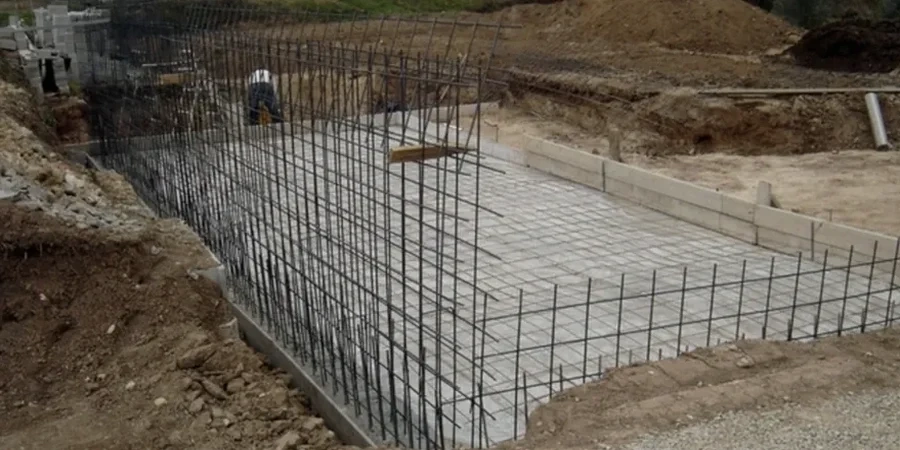
Local geotechnical conditions in Springfield Illinois
The Illinois State Geological Survey maps show the Sangamon River valley cutting through the city's west side. That paleovalley filled with soft alluvium—compressible, normally consolidated clays that can yield over 2 inches of settlement under modest footing pressure. In a 2019 project near Lanphier High School, ignoring the alluvium thickness led to a foundation repair that cost more than the original slab. Springfield sits in Seismic Design Category C per ASCE 7; the New Madrid and Wabash Valley seismic zones both contribute to the hazard. While peak ground acceleration is moderate, loose saturated sands in the alluvial zone carry a liquefaction susceptibility that can eliminate shallow foundation options. We evaluate this using field SPT blow counts and grain-size distribution via ASTM D2487. When the corrected SPT N-value drops below 8 in sand below the water table, the risk is flagged and we shift the recommendation toward ground improvement or a mat foundations design that bridges softer pockets.
Our services
The shallow foundation package for Springfield sites starts with a drilling program to define the till surface and alluvium base, then moves through laboratory consolidation and direct shear, and ends with a design memorandum that states net allowable bearing, anticipated settlement, and frost protection details.
Bearing Capacity & Settlement Design
We compute net allowable bearing using the general shear equation with Vesic factors, adjusted for groundwater position and footing embedment. Settlement is calculated layer-by-layer from consolidation test data (ASTM D2435), separating immediate and consolidation components. The report includes isobars of stress influence and a tabulated settlement-versus-footing-width chart for the structural engineer.
Frost-Protected Shallow Foundation Review
Springfield's 36-inch frost depth governs footing bottom elevation. We review subgrade preparation, capillary break details, and insulation placement for heated and unheated structures per IBC 1809.5 and ASCE 32. For unheated garages and entry canopies, we specify the required frost-wall depth and backfill drainage to prevent ice lensing in the lean clay that covers much of the city.
Questions and answers
What is the typical cost for a shallow foundation geotechnical report in Springfield?
A complete shallow foundation design for a typical commercial building in Springfield, including two to three borings, lab testing, and the bearing capacity report, runs between US$2,080 and US$3,430. The spread depends on the number of borings, the depth to competent till, and whether consolidation or swell testing is needed for the alluvial clays.
How deep do footings need to be in Springfield Illinois?
The bottom of footing must extend at least 36 inches below finished grade to meet the frost depth requirement adopted by the City of Springfield under IBC 1809.5. In practice, many designs go to 42 inches to account for site grading tolerances and to seat the bearing surface in undisturbed till rather than in the lean clay crust that freezes.
Can you use shallow foundations on the Cahokia Alluvium?
Sometimes. If the alluvium is thin—less than about 6 feet—we often excavate through it and bear on the underlying till. When the alluvium is thicker, we evaluate settlement carefully. A mat foundation can reduce bearing pressure enough to keep total settlement under 1 inch, but if the alluvium is saturated and loose, we typically recommend either overexcavation and recompaction or shifting to a deep foundation system.
What lab tests are required for shallow foundation design in Central Illinois?
We standardize around consolidation testing (ASTM D2435) to get compression index and preconsolidation pressure, direct shear on undisturbed samples for drained friction angle, and Atterberg limits to confirm the clay is below the expansion threshold. When the boring logs show sand layers below the water table, we add sieve analysis and hydrometer per ASTM D2487 to screen for liquefaction susceptibility.