A six-story medical office expansion near the Springfield Memorial Hospital campus encountered a lens of soft, saturated lacustrine clay at 14 feet below grade—right where the footing loads concentrated. The geotechnical report confirmed what local drillers see across Sangamon County: the stratigraphy inherited from the Illinoian glacial stage doesn’t always offer uniform bearing. In that project, the structural engineer and the geotech team opted for a stone column grid designed to transfer stress past the weak layer into the dense till beneath. When you work in Springfield Illinois, you learn that the Pleistocene deposits under the city can shift from stiff silty clay to loose sand within a hundred lateral feet, and that variability is precisely why stone column design here demands more than a textbook approach. The process starts with a detailed subsurface campaign—often combining SPT drilling to log refusal depths and CPT testing for continuous tip resistance and sleeve friction profiles. Once the compressible zones are mapped, the column diameter, spacing, and aggregate gradation are tailored so the composite ground mass meets the total and differential settlement criteria the IBC sets for the occupancy category. Springfield Illinois sites with remnant loess caps add another layer of complexity because the collapse potential under wetting must be mitigated before vibro-replacement begins, which is why we integrate in-situ permeability tests during the investigation phase to confirm drainage paths won’t trigger hydrocompaction during column installation.
In Springfield’s glacial stratigraphy, a well-designed stone column grid cuts differential settlement by 50–70 percent while doubling as a drainage path that shortens the pore-pressure dissipation window after a seismic event.
Service characteristics in Springfield Illinois
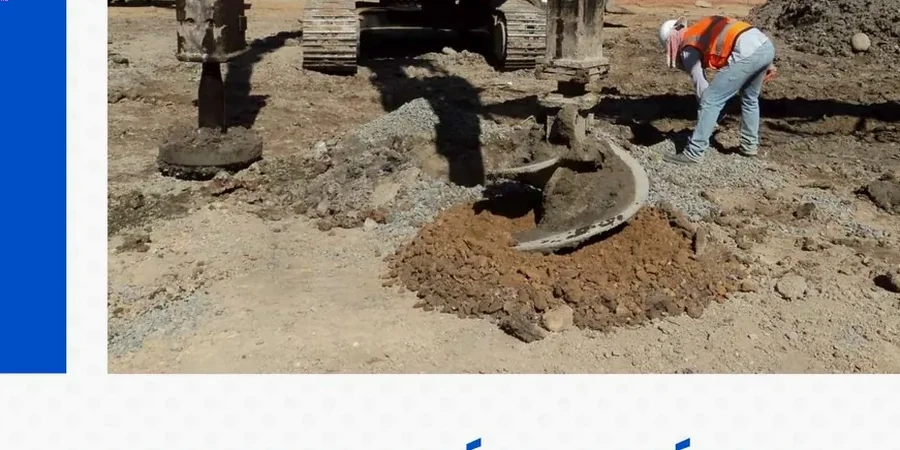
Local geotechnical conditions in Springfield Illinois
The surficial geology beneath Springfield Illinois is dominated by the Glasford Formation—a sequence of Illinoian-age glacial tills, outwash sands, and interbedded lacustrine silts that the Illinois State Geological Survey maps across the Springfield-Decatur region. This depositional mosaic creates one of the most persistent risks in local ground improvement: undetected soft pockets that can produce differential settlement exceeding 1 inch between adjacent columns if the stone column grid is designed on borehole data spaced too far apart. A second hazard arises in areas where the uppermost 5 to 10 feet consist of Peoria Silt, a loess unit that loses structure rapidly when wetted. If surface drainage isn’t controlled before and during vibro-replacement, the loess can collapse under the weight of the rig and the wetting from the jetting water, undermining the platform stability and compromising the upper column bulbs. Deeper down, isolated sand lenses within the till can liquefy under the short-period ground motions that the USGS National Seismic Hazard Model assigns to central Illinois, and unless the stone columns are designed with a drainage function—using clean, high-permeability aggregate and a continuous blanket layer—the excess pore pressure may not dissipate fast enough to prevent cyclic mobility. The design review must also check that the column load doesn’t punch through a thin, competent crust into a softer layer below, a failure mode that happened in a warehouse slab near the Legacy Pointe development and led to a costly re-leveling operation. A site-specific response spectrum and a layer-by-layer settlement analysis under both static and seismic load combinations are the only reliable guards against these outcomes.
Our services
The stone column design package we deliver for Springfield projects moves through four interconnected phases, each producing documentation that the local building department and the project structural engineer can review against the IBC submittal requirements.
Site-Specific Ground Improvement Design
Full analytical model using Priebe or finite-element methods calibrated to the Springfield Illinois subsurface log. Deliverables include column diameter, grid spacing, replacement ratio, settlement curves, and a column installation plan that identifies pre-drill zones where cobbles are anticipated.
Pre- and Post-Treatment CPT Verification
Cone penetration testing on a grid before design and after column installation to quantify the improvement in tip resistance and sleeve friction. The before/after overlay confirms that the treatment depth and lateral extent meet the design modulus and that no soft layer was bypassed during installation.
Load Test Program for Critical Footings
Zone load tests on single columns and column groups instrumented with telltales and settlement plates. The test protocol follows the FHWA ground improvement manual and provides the modulus of subgrade reaction that the structural engineer needs for mat or footing design over the improved ground.
Questions and answers
What does a stone column design package cost for a typical commercial building in Springfield Illinois?
Design fees for a stone column ground improvement package in the Springfield area generally fall between US$1,340 and US$4,560 depending on the building footprint, the number of CPT soundings required, and whether a load test program is included. A small retail pad on a simple site stays at the lower end, while a multi-story medical facility on variable till with a full instrumentation plan moves toward the upper bound.
How does the Springfield building department review a stone column submittal?
The City of Springfield Building and Zoning Division reviews ground improvement plans under the IBC Chapter 18 provisions adopted by the state. The submittal must include the geotechnical report with SPT and CPT logs, the stone column design calculations demonstrating that total and differential settlement stay within the allowable limits for the occupancy category, and the quality-control plan covering aggregate gradation, lift thickness, and amperage recording. A special inspector is typically required during installation to verify that the work conforms to the approved documents.
Can stone columns be installed in the winter when the ground is frozen in central Illinois?
Yes, but it requires site preparation beyond the typical scope. The frozen crust—often 12 to 18 inches thick in a normal Springfield winter—must be removed or thawed before the vibrator can penetrate without damaging the poker or deflecting off cobbles frozen into the till. Most contractors working in Sangamon County between December and February budget for frost removal and schedule a pre-construction meeting to confirm that the platform material stays workable throughout the installation window.