Too many projects in Springfield IL rely on generic bearing capacity values or simple pocket penetrometer readings when the actual failure envelope of the local soil tells a different story. The Sangamon County till and the underlying Pennsylvanian shale can hold moisture in ways that reduce effective stress more than a standard unconfined test will reveal, and when that happens the safety factor on paper isn’t real. A proper triaxial program, whether consolidated-undrained with pore pressure measurement or drained for long-term conditions, gives the design team the two numbers they actually need: effective cohesion and effective friction angle. Without them, retaining walls on the city’s gentle slopes or footings near the buried valleys of the Illinois Basin are being sized with assumptions, not data. Our laboratory runs each specimen through saturation, consolidation, and shear stages following ASTM D4767, and the resulting Mohr-Coulomb parameters feed directly into bearing capacity and slope stability models that reflect the real stratigraphy beneath Springfield IL. For projects where settlement is controlled by shear rather than consolidation—think narrow footings on stiff clay—the triaxial result is the single most important soil parameter on the datasheet. We see it regularly when contractors bring in samples from the east side commercial corridors and the numbers force a redesign that saves the foundation. Combining the triaxial data with a field investigation like spt-drilling builds a complete picture: depth-specific strength and stratigraphy together.
Effective cohesion and friction angle from a triaxial test are the two parameters that make or break a slope stability model in Illinois Basin soils.
Service characteristics in Springfield Illinois
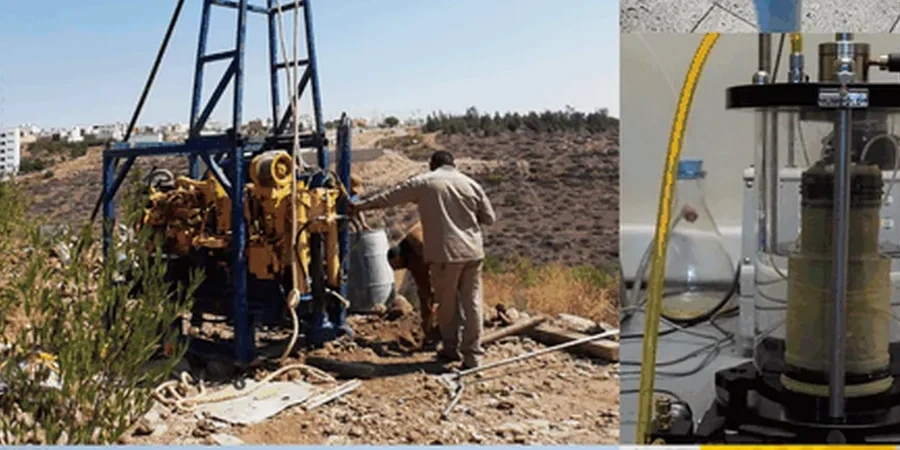
Local geotechnical conditions in Springfield Illinois
A seven-story hotel project on Springfield’s south side encountered a layer of soft, high-plasticity clay at 18 feet that wasn’t flagged during the preliminary geotechnical review because the unconfined compressive strength looked marginal but acceptable. When we ran a consolidated-undrained triaxial series on undisturbed Shelby tube samples from that layer, the effective friction angle came back at 18 degrees, not the 26 the designer had assumed from regional correlations. That gap meant the proposed spread footings needed to be widened by over 30 percent to keep the bearing capacity factor of safety above 3.0. The real risk with Springfield IL soils isn’t that they fail unpredictably; it’s that the undrained strength from cheaper tests masks how the soil behaves once pore pressures redistribute under sustained load. A drained triaxial test or a CU test with pore pressure measurement exposes that behavior before concrete goes in the ground. For deep excavations near the medical district, the lateral earth pressure distribution on shoring depends directly on the drained friction angle of the retained soil and the interface friction between soil and wall. Guessing those values from SPT blow counts introduces uncertainty that no amount of structural overdesign can fully cover. When the retaining-walls design calls for a cantilever or mechanically stabilized earth structure, the triaxial-derived friction angle becomes a non-negotiable input.
Our services
Our Springfield IL laboratory runs triaxial programs tailored to the specific loading and drainage conditions of each project. We coordinate directly with drilling crews to minimize sample disturbance between the field and the triaxial cell.
Consolidated-Undrained Triaxial (CU)
Three-stage CU testing with pore pressure measurement to determine effective stress strength parameters c′ and φ′ for saturated cohesive soils. Includes back-pressure saturation, B-value verification, and complete stress path reporting per ASTM D4767.
Consolidated-Drained Triaxial (CD)
Slow-rate drained shear testing for long-term stability analysis where pore pressures have fully dissipated. Applied to sandy lenses and low-plasticity silts encountered in the Springfield IL till sequence.
Unconsolidated-Undrained Triaxial (UU)
Quick undrained strength determination for short-term bearing capacity checks on fine-grained soils. Total-stress parameters suitable for temporary works and construction-phase stability verification.
Triaxial with Instrumentation
Specimens fitted with local strain transducers for small-strain stiffness measurement when the project requires deformation parameters for finite element modeling or seismic site response analysis.
Questions and answers
What’s the difference between a triaxial test and an unconfined compression test for Springfield IL clays?
An unconfined compression test runs the specimen with zero confining pressure and no pore pressure measurement. It gives you a total-stress undrained shear strength only. A triaxial test, run per ASTM D4767, applies controlled confining pressure that simulates the in-situ stress state and measures pore pressure during shear, so you get effective stress parameters—c′ and φ′—that account for how the soil’s strength changes when water can’t drain quickly. For Springfield IL glacial till and shale residuum, the drained friction angle from a triaxial test is the parameter that governs long-term slope stability and retaining wall design.
How long does a consolidated-undrained triaxial test take from sample to report?
For a three-specimen CU triaxial series on cohesive soil, the laboratory timeline is typically 10 to 14 working days. Saturation alone can take 24 to 48 hours per specimen to reach the required B-value above 0.95, and the shear stage runs at a controlled strain rate that often requires a full day per specimen. Reporting includes stress path plots, Mohr circles, pore pressure response curves, and tabulated effective and total stress parameters. Faster turnaround is possible for single-specimen UU tests when only total-stress strength is needed for a construction-phase check.
What does a triaxial test cost for a project in Springfield IL?
A complete three-specimen CU triaxial program with pore pressure measurement typically ranges from US$2,080 to US$3,030 depending on specimen diameter, saturation requirements, and the number of confining stress stages specified. Single-specimen UU tests fall at the lower end of that range. The final cost depends on sample condition upon arrival and whether drained or undrained shear is required. We offer a fixed-quote proposal once we review the project’s geotechnical data report and the number of specimens involved.
Do you need Shelby tube samples or can you test remolded specimens?
For design-level effective stress parameters we strongly prefer undisturbed Shelby tube samples—the in-situ structure and stress history of Springfield IL till directly affect the measured cohesion intercept. Remolded specimens can be prepared for projects where the soil will be compacted as engineered fill, but those results represent the remolded state only and should not be used to characterize natural ground. We coordinate with local drilling contractors to ensure tube diameter, sampler advancement rate, and transport conditions meet ASTM D4220 requirements for minimum disturbance.