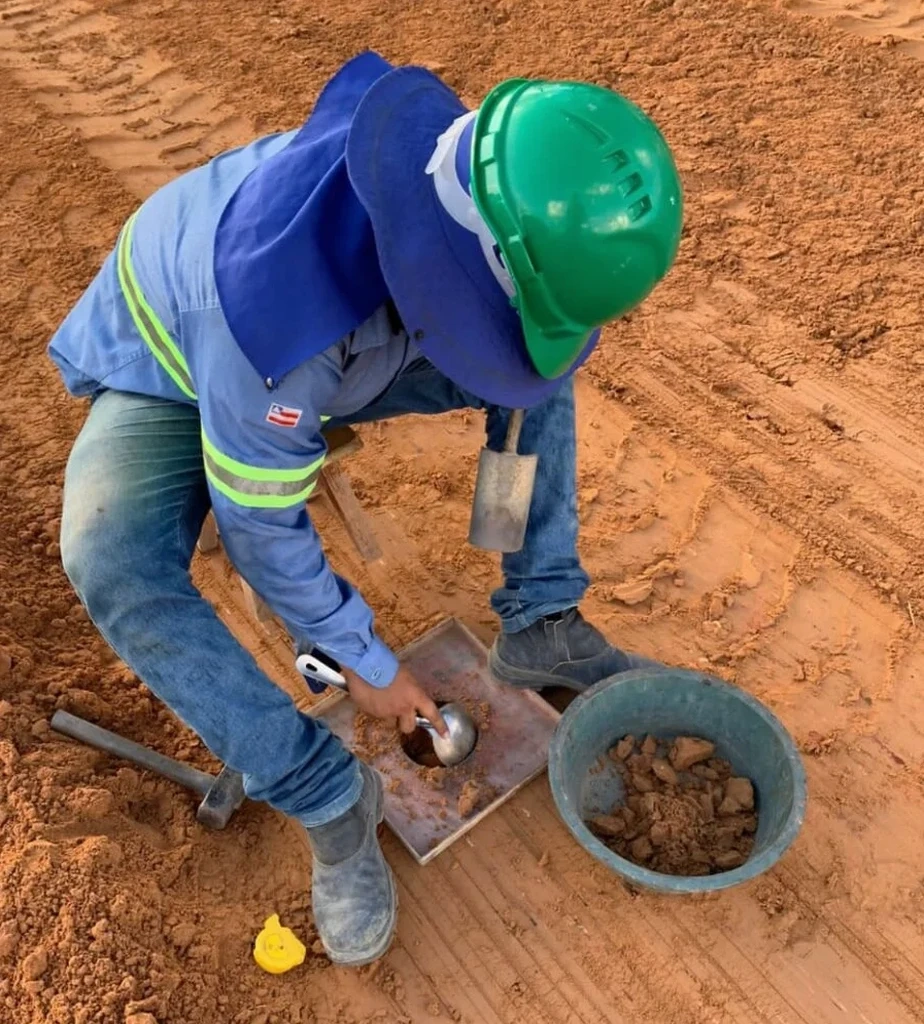
Springfield sits on glacial till and loess deposits that can look solid at the surface but hide soft lenses just a foot down. The Sangamon River valley also left pockets of alluvial clay that respond poorly to standard compaction effort. A field density test with the sand cone method gives you the in‑place density number before the inspector asks for it. We run ASTM D1556 tests on subgrade, utility backfill, and structural fill across Sangamon County, from the MacArthur Boulevard corridor to new subdivisions near Chatham. When the spec calls for 95 percent modified Proctor, you need a calibrated sand cone and a technician who knows how to avoid moisture loss between the field and the scale. We also pair the test with a grain size analysis when the fill material source changes mid‑job.
ASTM D1556 gives you a direct measurement — no radiation source, no correlation curves, just mass and volume.
Service characteristics in Springfield Illinois
Local geotechnical conditions in Springfield Illinois
Springfield averages 37 inches of rain per year and the frost line reaches 36 inches. Water that infiltrates poorly compacted utility trench backfill freezes and thaws through 30 to 40 cycles each winter, creating differential heave under pavements and footings. The Illinois State Geological Survey maps show pockets of compressible Cahokia Alloformation clay within the city limits — material that loses bearing capacity fast when moisture rises above optimum. Skipping a sand cone test on a waterline trench along Stevenson Drive can mean a pavement dip six months after the patch. Backfill that passes the test at 98 percent standard Proctor holds its shape through the first wet season. If the subgrade shows low compaction near the Illinois EPA stormwater infiltration zones, we flag it before the liner goes in.
Our services
Our compaction testing package for Springfield covers the full chain — from lab Proctor curves to field density verification. Every technician carries a calibrated scale, sand cone kit, and moisture tester in the truck.
Standard & Modified Proctor
ASTM D698 and D1557 lab curves run on your actual fill material. We need 40 lb of soil to give you the maximum dry density and optimum moisture content the sand cone test references.
Sand Cone Field Density
On‑site density test per ASTM D1556 at the frequency your spec requires. Wet density, dry density, and percent compaction reported by lift and station.
Rush Inspector Package
Same‑day PDF report with photo documentation and GPS coordinates. Formatted for direct submission to City of Springfield Public Works or the consulting engineer.
Questions and answers
How much does a sand cone field density test cost in Springfield?
Single sand cone tests in the Springfield area run between US$90 and US$150 each, depending on mobilization distance and how many tests we perform in one visit. Most commercial sites batch five to ten tests per day, which brings the per‑test cost down.
How soon can you get to a site near downtown Springfield?
We keep a technician on standby for Sangamon County projects. For sites inside the city limits — from the medical district to the Stanford Avenue corridor — we can typically be on‑site within 24 hours of the call. Same‑day dispatch is available for urgent backfill sign‑offs.
What is the difference between a sand cone test and a nuclear density gauge?
The sand cone method per ASTM D1556 measures density directly by excavating soil and measuring the hole volume with calibrated sand. A nuclear gauge estimates density from gamma radiation backscatter. Sand cone avoids radiation safety paperwork and calibration drift, but takes about 20 minutes per test versus five minutes with a gauge. Many Springfield specs still require sand cone correlation tests even when a nuclear gauge is used for production.
What Proctor value should I target for utility trench backfill?
City of Springfield standard details typically call for 95 percent standard Proctor (ASTM D698) for utility trench backfill under pavement and 90 percent in landscaped areas. We run the lab Proctor on your material first, then the field sand cone test references that maximum dry density to calculate percent compaction.
Can you test gravel base course with the sand cone method?
Yes, but with limits. ASTM D1556 works on material with maximum particle size up to about 1.5 inches. For open‑graded CA‑6 or CA‑7 stone we often switch to a water replacement method or use a larger test hole volume. We will let you know if the gradation is too coarse for the standard 6‑inch sand cone plate before we start.