A concrete batch truck rolling down Dirksen Parkway toward the jobsite signals the start of a pavement that should last 30 years—but only if what sits beneath it is dialed in. Rigid pavement design in Springfield Illinois starts with a slipform paver or fixed-form setup laying a stiff portland cement concrete slab, transferring axle loads by beam action rather than aggregate interlock. The flat, open terrain here masks what actually governs performance: the thick, high-plasticity glacial till that swells when wet and shrinks when dry. We pull Shelby tubes from that subgrade and run ASTM D1883 CBR alongside moisture-density curves to feed the Westergaard equations, so slab thickness and joint spacing match the real bending stresses. If you're paving a truck terminal off I-55, we also tie in CBR road testing to validate the compacted subbase before the first concrete pour, making sure the modulus of subgrade reaction k doesn't fall apart three winters from now.
Springfield's high-plasticity glacial till doesn't forgive guessing—a rigid pavement design built on assumed k-values here cracks before the second winter.
Service characteristics in Springfield Illinois
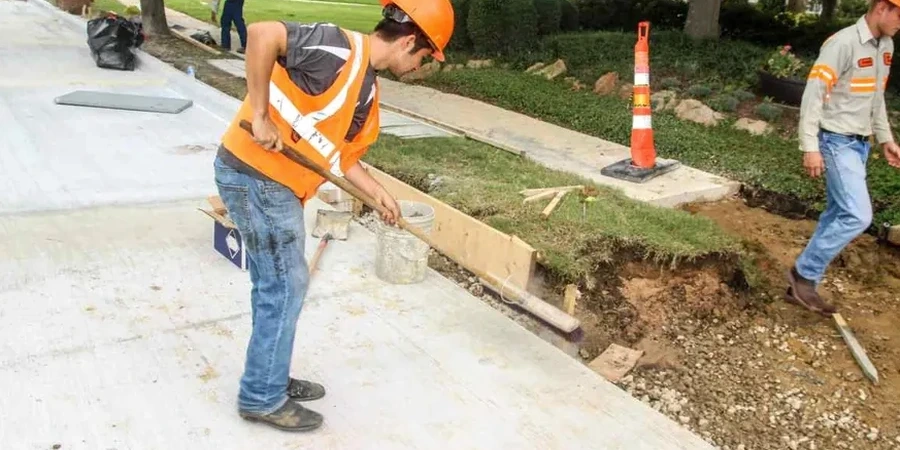
Local geotechnical conditions in Springfield Illinois
The mistake we see over and over in Sangamon County is treating the subgrade k-value as a textbook number instead of measuring it. A contractor assumes k=100 pci because the soil 'looks firm,' pours a 7-inch industrial slab, and by March the panel corners are rocking and pumping fines after freeze-thaw cycles. Springfield's winter moisture freezes in the upper subgrade, and when that ice lens melts, the saturated clay loses bearing fast under repeated axle loads. What follows is faulting at transverse joints, spalling at dowel bars, and a $200,000 slab that needs diamond grinding or full replacement before the building is even occupied. A proper rigid pavement design sequence—subgrade investigation, k-value verification, Westergaard edge stress analysis, and joint detailing per ACI 360R—catches that before the first yard of concrete leaves the batch plant.
Our services
Our rigid pavement design workflow for central Illinois projects covers the full stack—from subgrade sampling to joint detailing. Each deliverable is signed by a licensed engineer familiar with Springfield's glacial geology.
Industrial Slab & Joint Design
We size slab thickness using Westergaard edge-load analysis, specify dowel baskets per AASHTO M254, and detail saw-cut timing so random cracking doesn't show up on your warehouse floor.
Subgrade Evaluation & k-Value Testing
In-situ plate load tests per ASTM D1196 on the compacted subbase, paired with laboratory CBR and consolidation data from the native till, give you a k-value that reflects actual moisture conditions, not a textbook guess.
Questions and answers
What does rigid pavement design cost in Springfield IL?
For a typical commercial or industrial project, the engineering design package—including subgrade investigation, k-value determination, slab thickness analysis, and joint detailing—runs between US$1,630 and US$6,210 depending on the square footage and number of test locations. The fee covers the site visit, plate load testing, laboratory concrete mix review, and the stamped design report.
How deep do you investigate the subgrade for a rigid pavement in this area?
We typically sample and test the upper 4 to 6 feet below subgrade elevation, which captures the active zone where seasonal moisture changes and frost action occur. In Springfield's glacial till, that depth reaches well below the 32-inch frost line and into the stiff clay that governs the long-term modulus of subgrade reaction.
What joint spacing do you recommend for outdoor concrete pavements in central Illinois?
For plain jointed concrete pavement in this climate, we follow ACI 360R and typically specify joint spacing between 12 and 15 feet, with the ratio of slab length to thickness kept under 24:1. The exact spacing depends on the concrete's flexural strength, slab thickness, and the measured k-value of the subgrade, not a generic rule of thumb.
Do you handle both the geotechnical investigation and the structural slab design?
Yes, the same engineering team manages the full scope. We drill the subgrade borings, run the laboratory strength and consolidation tests, compute the k-value, analyze edge and corner stresses, select the concrete mix parameters, and deliver a stamped set of rigid pavement design drawings with joint layout, dowel schedules, and subbase specifications.