A recent warehouse pad off Dirksen Parkway hit a lens of silty clay that the contractor swore was structural fill. It wasn't. Three days of rain turned the subgrade into soup, and the only way to salvage the schedule was a rapid grain size curve to prove the material was frost-susceptible under IDOT specs. In Springfield, Illinois, where the surficial geology swings from loess and Wisconsinan till to Sangamon River alluvium, guessing particle size distribution burns budgets. Our lab runs the full stack: mechanical sieve analysis for the coarse fraction above 0.075 mm plus hydrometer sedimentation for fines, delivering a complete plot from gravel down to colloidal clay. For deep foundations near the Illinois Basin bedrock, we often pair the hydrometer data with Atterberg limits to nail the USCS classification before committing to a foundation type.
A gradation curve without the hydrometer portion is half a diagnosis—Springfield's glacial fines control permeability, frost action, and compaction response.
Service characteristics in Springfield Illinois
Live process video
Local geotechnical conditions in Springfield Illinois
Central Illinois winters cycle hard through freeze-thaw, and Springfield's silty soils are notorious for frost heave when the fines percentage and capillary rise align badly. A grain size analysis that skips the hydrometer leaves you blind to the silt-clay ratio that drives that vulnerability. Equally risky is assuming a well-graded gravel based on a quick field inspection. We've seen crushed limestone base course from a local quarry segregate during placement, creating zones of uniform gradation that collapse under traffic loading. The lab report catches that by computing the coefficient of uniformity and curvature directly from the plotted curve. For earth dams and levees along the Sangamon River, internal erosion potential hinges on the shape of the gradation envelope, and misclassifying a gap-graded soil as well-graded has real consequences for long-term structure integrity.
Our services
We deliver gradation data formatted for geotechnical reports, IDOT submittals, and earthwork specifications. Every curve is reviewed by a technician who understands Springfield's glacial stratigraphy.
Full Sieve + Hydrometer Package
Combined mechanical sieve analysis and ASTM D422 hydrometer test on a single sample. Includes semilog gradation plot, Cu/Cc computation, and USCS classification with group symbol and name.
Wash Sieve and Fines Content
Rapid determination of percent passing the No. 200 sieve by wet washing, ideal for compaction control, filter compatibility checks, or screening samples before advanced testing.
Questions and answers
How much does a grain size analysis cost in Springfield?
A standard sieve plus hydrometer package typically runs between US$100 and US$190 per sample, depending on whether it's a single-point classification or a full engineering gradation with multiple hydrometer readings. Turnaround time and sample condition also affect the final figure.
What's the difference between a sieve analysis and a hydrometer test?
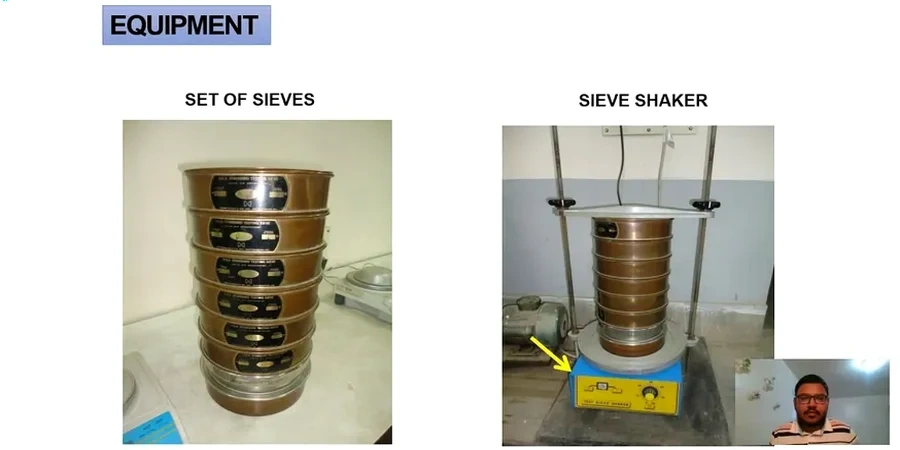
The sieve analysis covers the coarse fraction, shaking the sample through a stack of screens from 3 inches down to the No. 200 sieve (75 microns). The hydrometer test picks up where sieves stop, measuring the sedimentation rate of silt and clay particles in a water column to build the fine-grained portion of the gradation curve.
Do I really need the hydrometer portion for my project?
If your soil has more than about 12% passing the No. 200 sieve, yes. Without the hydrometer you can't determine the silt-clay split, which controls frost susceptibility, drainage behavior, and the correct USCS classification. For pavement subgrade evaluation in Illinois that distinction matters.
How long does the full test take?
A combined sieve and hydrometer analysis usually requires 3 to 5 working days from sample receipt. The hydrometer portion alone runs 24 hours minimum for sedimentation readings, plus sample preparation and dispersion time.
What sample size do you need?
For a complete gradation we need roughly 2 to 5 kilograms of material in a sealed bag, representative of the stratum in question. If the sample contains particles larger than 3 inches, we'll need more material to run the coarse sieve portion accurately. More info.